
Some Mens Timepieces Brands Live in the Quiet

The light shifts before the coffee cools. It moves across the concrete floor of the café, the one on the corner where the city’s hum is still a low murmur. Mornings here have a rhythm, a sequence of quiet rituals.
The turn of a page. The clink of ceramic. Through the window, the first walkers trace their usual paths. We notice these things. There's a steadiness to it, a continuity that feels right. The day hasn’t really begun, but its story is already being written in these small, repeated moments.
On the wrist, a watch catches that sliver of new light. It’s part of the scene, as expected as the espresso machine’s soft hiss. It isn’t there to be noticed, but to be present. A quiet companion for the day ahead—a day of doing, of moving, of finding a pace in a city that never really stops. This is where time begins for us.
Time as a Lived Experience
We don't see time as something to be managed or conquered. It’s a current we move with, a looping story where each day is a familiar chapter, slightly rewritten. We keep this philosophy close. It’s in the quiet routines that anchor us, from the first coffee to the last walk home under streetlights.
These moments are where time is actually lived, not just measured. It’s a sensory experience, a feeling, a rhythm. The cold, mechanical measurement of seconds and minutes comes last. This idea sits at the core of how we think about the objects we carry with us, day after day.
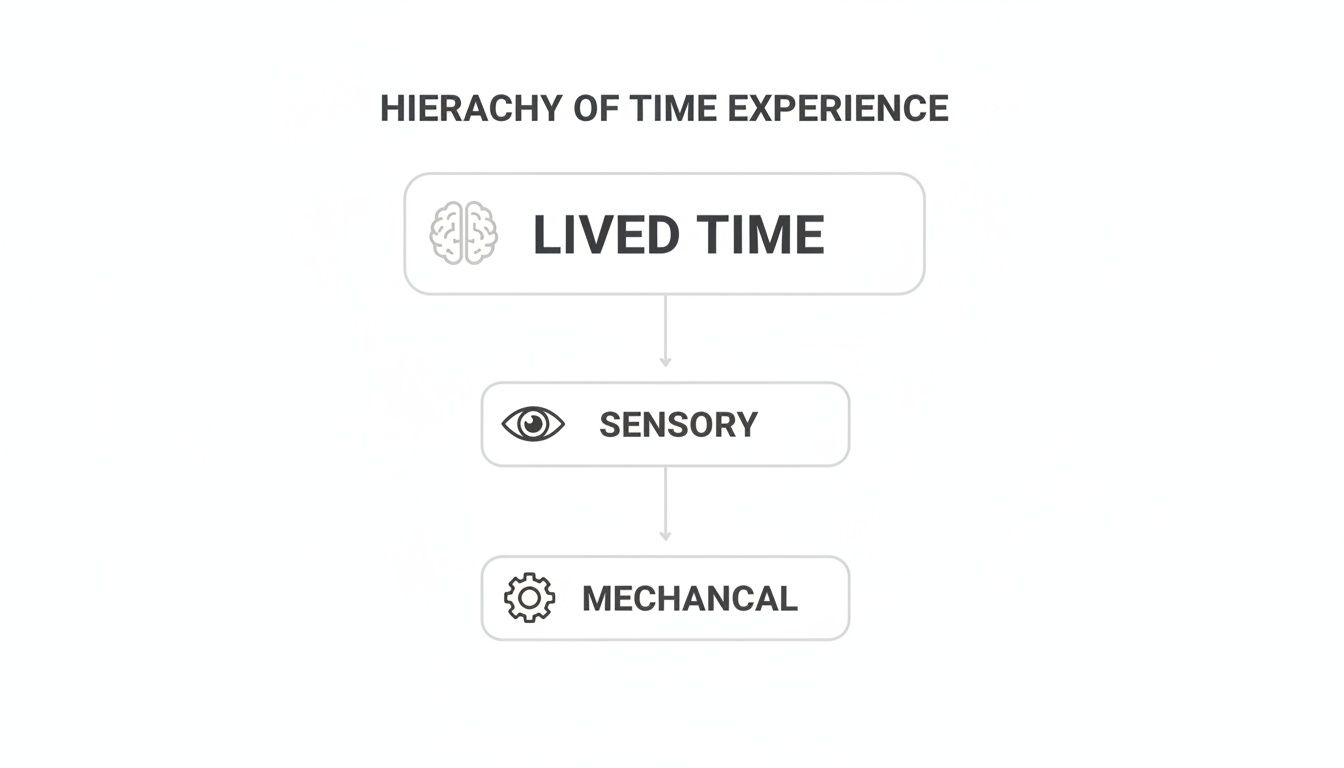
The watch on the wrist is part of this lived time. It’s an object that stays, moving from one scene to the next. It’s there for the late night at the desk and the early morning back at the same café. This is our quiet story, a narrative you can dip into within our archive of reflections.
We don’t rush. The day unfolds at its own pace, and we move with it. For now, there is only this moment and the steady presence of a timepiece ready for what’s next. The city is waking. The story continues.
Finding a Place in the City of Watches
Exploring the world of watches is like walking through a city. Each brand has its own neighborhood, its own character. Some are the old, historic districts—heritage brands built on generations of tradition, their pieces marking grand achievements.
Then there are the industrial zones, where function dictates form. The watch brands here are tools, designed for pilots or divers. They are about precision and resilience, not aesthetics.
And then there are the quieter streets, the ones lined with design studios and small galleries. The brands in this neighborhood are about a feeling. They have a calm confidence, blending into a day instead of defining it. They are part of the outfit, part of the routine.
This is where we find ourselves. Not in the world of grand statements or specialized gear, but in the rhythm of the everyday. The focus shifts from what a watch represents to how it feels to live with it.
A Small, Considered Rotation
Some people collect watches, hunting for rare pieces. Others see them as investments. We are drawn to a third way: rotation.
Rotation isn’t about acquiring more. It’s about curating a small set of versatile, well-loved pieces that serve different parts of a life. It’s a philosophy of restraint, valuing use over ownership. A few trusted companions see the light of day, gathering the small marks of a life in motion. This changes the question from “what’s next?” to “what stays?”
It builds a connection. A simple stainless-steel watch is the daily driver, its familiarity a grounding presence. A piece with a leather strap might appear on the weekend, signaling a shift in pace. To capture that character, brands rely on thoughtful watch product photography.
This way of thinking leads to a more intentional wardrobe of objects. It’s less about owning everything and more about having what you need. A quieter, more personal way to engage with the world of watches. It’s the philosophy that guides the small rotation of timepieces we design for men. The goal is continuity, not consumption.
The Quiet Language of a Watch
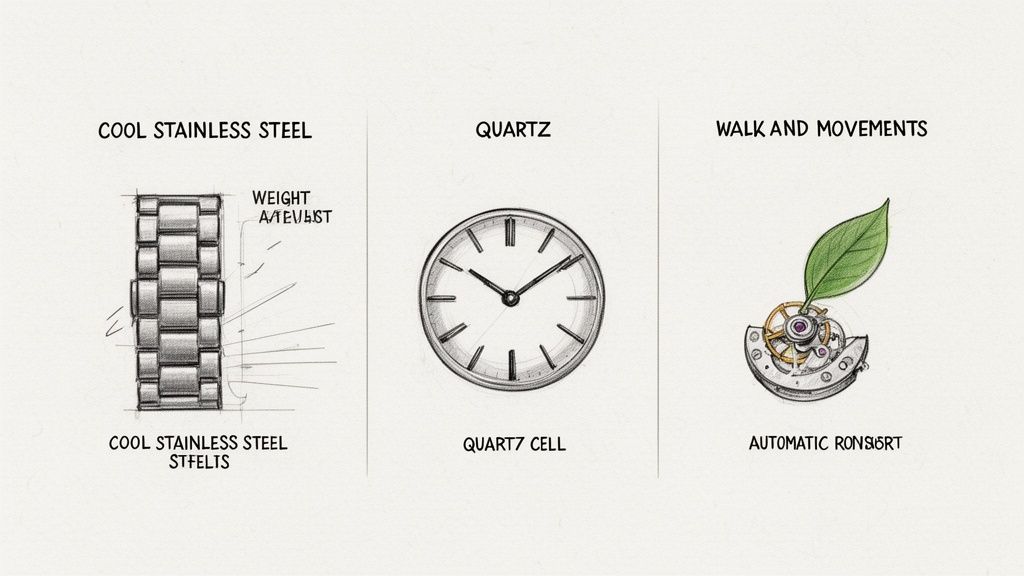
A watch is something you feel. It has a weight, a temperature against the skin, a pulse of its own. These sensations come from two places: its materials and its movement. The body and the heart.
The cool, solid feel of stainless steel on a humid Dubai evening is grounding. It’s a material for real life, with a quiet strength that holds up. Over time, it collects small marks, a map of the days it has been with you.
Precious metals tell a different story. They catch the light with a warmer glow, often reserved for more deliberate moments. We have shared our own thoughts on how gold fits into a modern watch collection. This appreciation for materials is part of the watch culture here.
The regional market understands this. It leans into both steel and precious metals, with sales figures that speak to a deep, lasting connection to these tangible objects. This isn't just a trend; it's an appreciation for things that stay. For more detail, there are regional watch market insights on indexbox.io.
The Heartbeat Within
If the case is the body, the movement is its heart. It’s the engine driving the hands, defining the watch’s rhythm. You will mostly find two types.
First is the quartz movement. The reliable, battery-powered workhorse. You know it by the distinct tick of the second hand. It is pure utility—always ready, asking for nothing but a new battery every few years. It just works.
Then there’s the automatic movement. This is a miniature, self-winding engine powered by you—by the kinetic energy of your own motion. The act of walking to the metro or lifting a coffee cup is enough to keep it alive. The second hand on an automatic doesn't tick; it sweeps in a smooth, fluid motion that feels more organic. It’s a quiet pulse that mirrors your own.
Neither is better. A quartz watch offers certainty. An automatic asks for a partnership. If you leave it on a nightstand for a few days, it will stop, waiting for you to pick it up again. Setting the time becomes a small, satisfying ritual. The choice is about what you prefer: effortless utility or a quiet, daily interaction.
The Watch as Part of the Outfit
A watch becomes a quiet character in the small scenes of a life. The focus is not on the object itself, but on how it lives alongside you, a natural part of a personal uniform.
Think of an afternoon walk, a linen shirt with the sleeves rolled up. The watch on your wrist, with its cool steel bracelet, feels like an extension of the moment—calm, grounded, present. It catches the light but never steals the scene.
Now, an evening. The city lights paint long shadows. The outfit is different—a dark, comfortable knit for a late work session. The same watch is there, but its character has shifted. Against the soft texture of the sweater, its polished surfaces seem more defined, more intimate. A familiar weight in the low light.
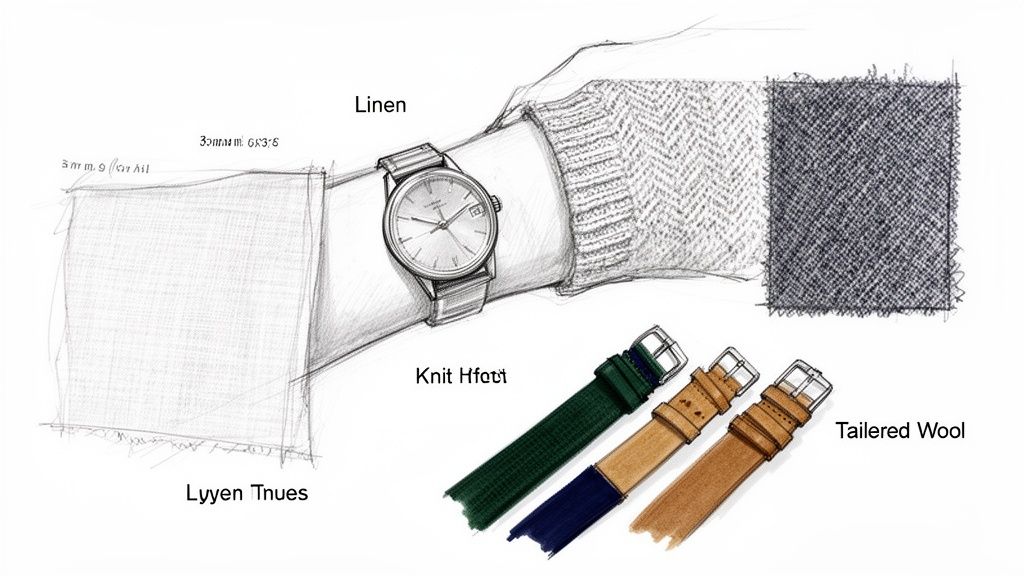
The same watch can feel completely different depending on what you pair it with. A worn leather strap gives it a softer feel. A nylon one prepares it for a more active day. But the conversation goes deeper. Against raw denim, a steel watch feels functional. With tailored wool, it appears sharper, more architectural.
This interplay is about creating a cohesive feeling. It’s the quiet confidence that comes from wearing things that belong to you, and to each other. Tools like an AI outfit generator for personalized styling explore how one watch can work across an entire wardrobe.
Ultimately, the best objects are the ones that disappear into the rhythm of a day. They are just there, woven into the fabric of your routine. The goal isn’t a collection of flashy pieces in a box. It’s finding a companion. An object so natural on your wrist you forget it’s there, until you need it. We touch on this in our stories about casual, everyday style.
The Quiet Act of Keeping Time
There is a quiet satisfaction in keeping things. In a world of the next new object, choosing to maintain what you already own is a small act of continuity. We see this in the simple rituals of care—polishing shoes, mending a shirt, or winding a watch that has been with you for years.
When you repair something, you show it respect. You acknowledge the skill that made it and honor the memories it carries. That tiny scratch on the bezel is not a flaw. It’s a souvenir from a late night or a frantic commute. It has earned its place. This is about valuing what lasts, a step away from a disposable culture.
This same mindset applies to a watch collection. It is not an endless hunt for more. It is about rotation—a small, thoughtful set of versatile timepieces for different moods. This is about restraint. Not hoarding watches, but curating a handful of trusted companions. Maybe one for the steady rhythm of the work week, another for the unhurried pace of the weekend.
This shift toward longevity is real. You see it in the growing market for pre-owned watches. That market is gaining traction here, driven by an appreciation for classic movements and vintage designs, which is explored in these insights into the pre-owned luxury watch market on cognitivemarketresearch.com.
Choosing repair and rotation is a quieter way to enjoy the things we love. It’s about building a relationship with possessions and giving them the care they deserve. Our own approach to watch repair services is built on this principle. We are here to ensure a watch remains a constant, reliable companion.
Spectrum: A Companion for the Everyday
We don’t make watches for collectors. We are not chasing trends. Our focus is on that one steady companion—the watch that moves through a day right alongside you. We design for the founder with a notebook, the creative exploring the city on foot, the night owl finding their rhythm while the world sleeps.
This idea drives everything we do. We started in Dubai to make everyday watches that feel like they have been part of your life for years. They are partners, not accessories, there for the small moments and the long nights.
Our watches are built from honest stainless steel. It has a reassuring weight, a character that lives with you, picking up the small marks that tell your story. We see those not as imperfections, but as memories. The colors we choose—deep greens, muted blues, classic grays—are pulled from the shifting light of the city. They are meant to complete a look, not command it.
We believe in a simple philosophy: rotate, don’t accumulate. Repair, don’t replace. We build things to last, using quality materials and timeless designs. The point is to have a relationship with the things you own, to see them as partners for the long haul.
Among all the mens timepieces brands, our approach is simple. We offer a steady, reliable presence on your wrist. A quiet companion for a life in motion.
The Loop Continues
The light has changed again. The midday sun has softened into a warm, dusty gold, spilling across the desk and catching the rim of a cold coffee cup. The city’s rhythm is shifting from the energy of the workday to the steady pulse of the evening commute.
The scene is a mirror of the morning, played in reverse. The walkers head home. It’s a quiet, unfolding story, another chapter drawing to a close. There is a sense of continuity, not finality. The day is done, but time keeps moving.
There is no grand finale. The work will be there tomorrow. The café will open at its usual time. The small routines that anchor us will repeat, each a little different than the last. We find a comfort in this looping, quiet rhythm.
The watch on your wrist is still there, a silent observer of this slow fade from day to night. Its steel case catches the warm glow of a desk lamp instead of the cool morning light. It has been a constant companion through every email, every quiet moment of thought. It doesn’t mark an ending. It just marks the continuation. Tomorrow will look a lot like today. And your watch will be there for it, ready for another loop. The story doesn’t end. It just continues.