
The Quiet Continuity of a Watch
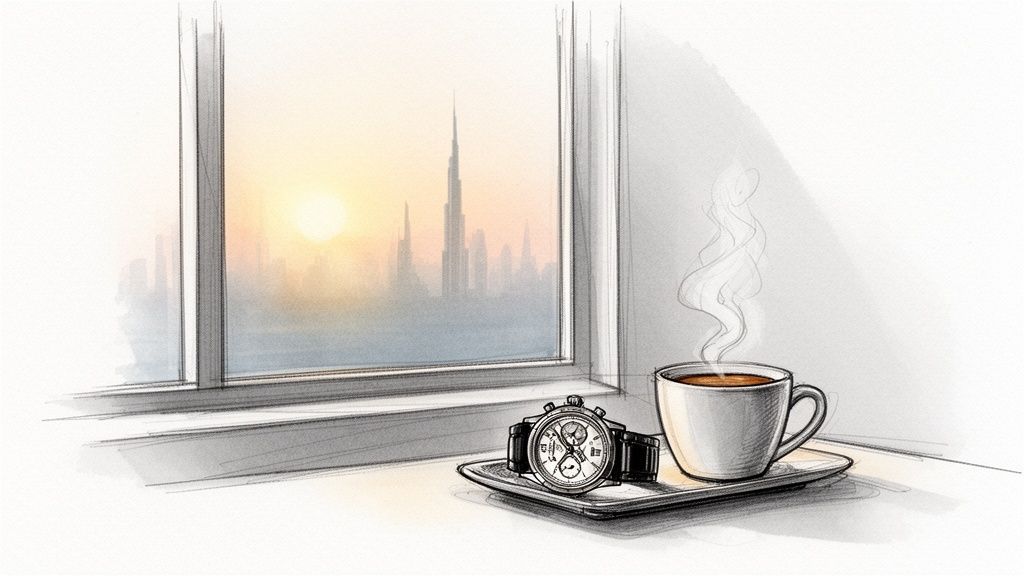
The coffee is cooling on the desk. Outside, the first signs of the morning commute begin to trace lines across the city, a familiar rhythm starting up again. From this high up, the sounds are muted, distant. The light shifts from grey to a soft, warm white, catching the edge of the window frame and creeping across the floor.
It’s a moment that feels exactly like yesterday’s, and likely tomorrow’s too. The city wakes up in its own time, but in here, the pace is set by small, repeated actions. The turn of a page. The weight of a ceramic mug. The quiet presence of a watch on the wrist, its hands marking time that doesn’t feel urgent. It’s just there, part of the scene.
Time's Unfolding Rhythm
We notice how days are built on these loops. The same walk to the metro, the same corner café, the same chair pulled up to the same desk. There’s a quiet comfort in this repetition. It’s not about monotony, but continuity—a steady thread running through the noise.
Each day, the founder returns to his sketchbook, the night worker makes her way home as the sun rises, and the city walker traces a path worn by countless footsteps before. Their stories are different, but the rhythm is shared. It’s a silent agreement that time moves forward, but some things remain. This is the world we design for, one where objects are not meant to disrupt the flow, but to move within it.
We don’t believe in chasing novelty. The search for something new every day can be exhausting. Instead, we find meaning in the things that stay. A favorite jacket, a worn-in pair of shoes, a watch that has seen a thousand mornings just like this one. These objects become part of the story, silent observers of a life unfolding. They don’t demand attention; they simply exist alongside you. We’ve explored this feeling before, in a piece on the quiet mastery of time.
This sense of permanence is what we keep coming back to. It’s a grounded feeling, an understanding that style is not about the next big thing, but about the things that endure. The hands on the dial sweep on, indifferent to trends. They measure the hours of focused work, the minutes spent waiting for a friend, the seconds of a quiet pause before the day truly begins.
Objects in the Scene
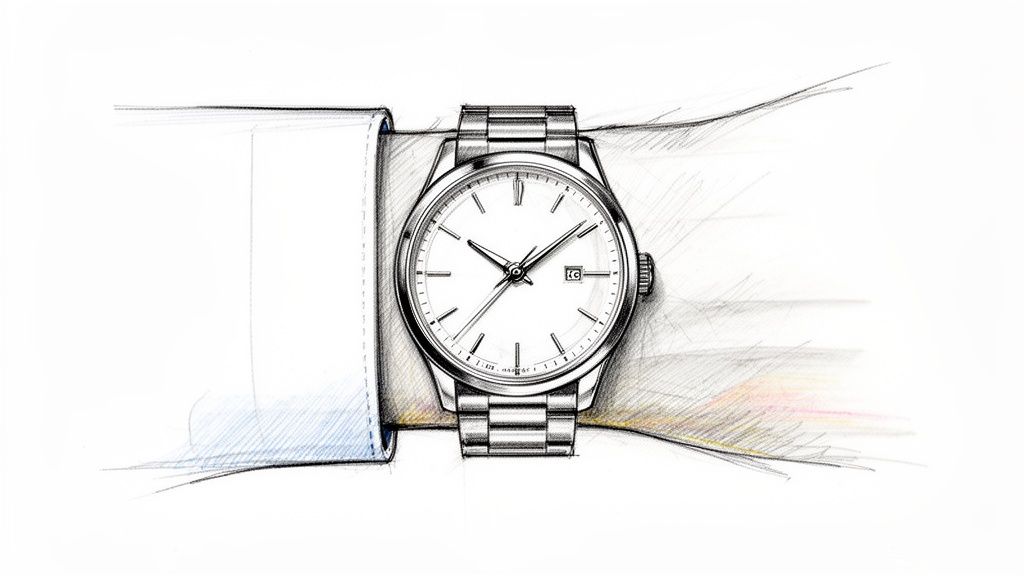
The outfit for the day is chosen without much thought. A crisp white shirt, dark trousers. It’s a uniform of sorts, a choice made long ago that still feels right. It simplifies the morning. The final gesture is fastening the watch, its cool steel a familiar weight on the wrist.
The watch isn’t the centerpiece. It’s just another element in the frame, alongside the leather briefcase and the black notebook filled with yesterday’s thoughts. It catches the light as a hand reaches for a door handle, disappears under a cuff during a meeting, and reappears in the soft glow of a restaurant later that night.
These objects travel with us. They are extensions of our routines, carrying the faint marks of daily life. A scuff on a shoe, a crease in a jacket, a hairline scratch on a watch crystal. These aren’t imperfections. They are markers of time lived, small stories embedded in the things we carry. You’ll find this thread in many of our stories about the life of a watch.
A Philosophy of Lasting Design
When we design a watch at Spectrum, we think about these scenes. We consider the person pulling on a jacket as they head out for the evening, or the creative staring at a blank page, their watch the only thing moving in the quiet room. We create watches for these moments, for the people who live them.
Our philosophy is simple: everyday watches, built to last. We focus on clean dials, durable materials like stainless steel, and reliable movements. The goal is not to create a statement piece, but a constant companion. It’s why we believe in rotation over collecting—a few trusted timepieces that adapt to your days, rather than a box of watches left unworn. You can see this approach in our entire men's collection.
We also believe in repair over replacement. An object that stays with you for years will inevitably show signs of wear. We see that as part of its character. A watch should be serviceable, its life extended through care, not ended when something newer comes along. This idea of longevity is at the core of everything we do. We've shared some of our thoughts on timeless metals and their enduring appeal before.
The Day Continues
The afternoon light softens, casting long shadows across the office. The day’s energy begins to shift, winding down. Soon, the commute will reverse, taking people from the city’s core back to quieter neighborhoods. The watch on the wrist has tracked it all, its purpose steady and unwavering.
Later, it will rest on a bedside table, its ticking almost silent. Outside, the city will find a different rhythm, one of late-night conversations and distant sirens. The day doesn’t so much end as it transitions. The watch keeps its time, ready for the morning when the cycle begins again.