
The Quiet Confidence of a Casio Solar Watch

The city winds down. From a quiet corner in a late-night café, the streetlights paint long, soft lines on the pavement. The last order of the evening cools on the table, a small ritual marking the end of another day’s rhythm. The air is still, settled.
It’s in these moments, we notice, that certain objects feel constant. The heavy ceramic of the cup, the familiar weight of a worn-in jacket, the watch on a wrist. It doesn’t demand attention. It’s just there, a silent keeper of the hours that have passed and the ones still to come. The day’s light has faded, but some things carry their own energy forward.
How a Watch Finds Its Rhythm
There is a quiet satisfaction in things that don’t ask for much. In a world of updates and notifications, of endless cables and low-battery warnings, some objects operate on a different frequency. They are not tethered to a wall; their pulse is synced to something more fundamental, like the ambient light of a room or the slow arc of the sun.
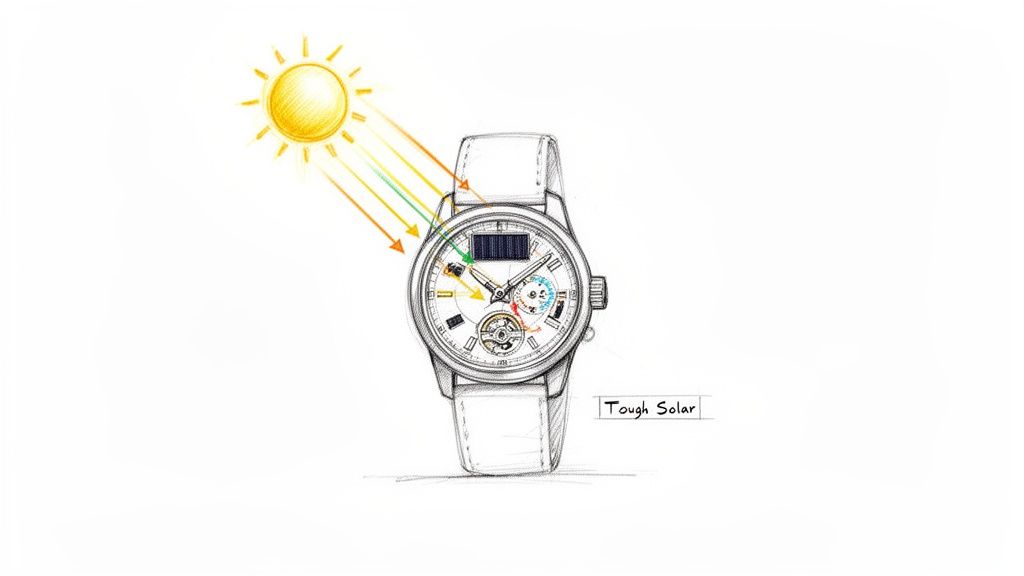
We think of this continuity as a form of self-sufficiency. A watch face that hides a tiny solar cell is always working in the background, converting light into a quiet, continuous trickle of energy. It doesn’t distinguish between the intense glare of a summer afternoon or the soft glow from a bedside lamp. It simply takes what is available.
This isn’t a grand gesture of technology; it’s a simple, self-sustaining cycle. It’s the kind of persistence we admire, a system that works without fuss. It removes the small chore of replacing a battery every few years—a quiet step away from a throwaway culture. It is less about performance and more about presence.
All that collected energy finds a home in a high-capacity rechargeable cell, engineered to last for years. It creates a reserve that allows the watch to keep its time for months, even if left in a drawer. This cycle of charging and using becomes an unnoticed, dependable part of the day. The watch is simply there, a reliable marker of time, never demanding attention. It’s an object that holds a quiet confidence, built not for a fleeting trend but for the long, unfolding story of a life. We explore this idea of enduring objects often over at TimeMastery.
A Watch Built to Last
The character of an object is revealed in its quiet moments. The way a Casio solar watch behaves when left alone speaks to its design. It isn’t just about specs; it’s about a silent confidence that comes from within. It’s a tool built to just be, without constantly needing something from you.
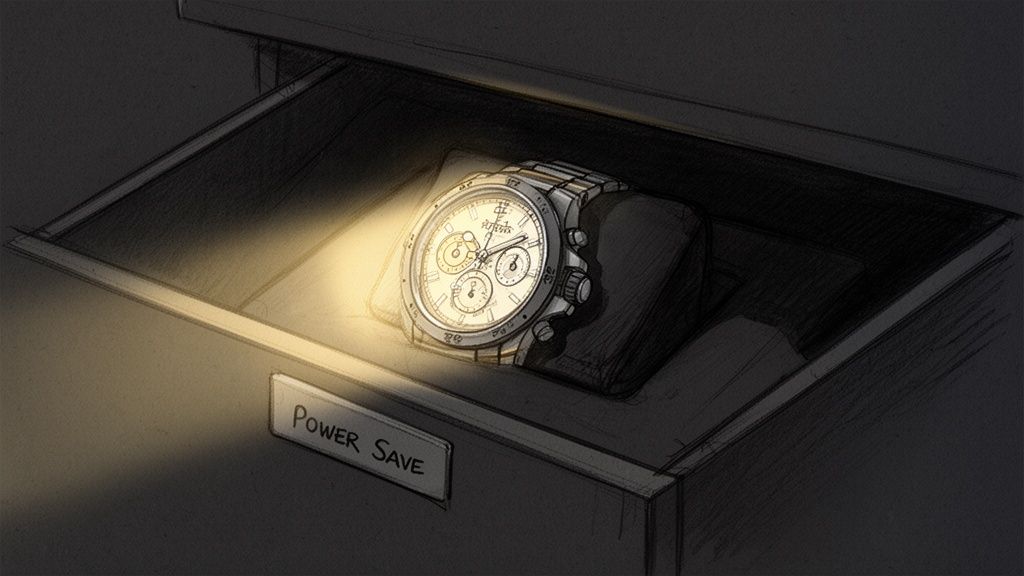
We see this in its power-saving mode. The watch doesn’t just stop when left in a dark space. It enters a state of deep sleep. The hands pause, conserving every drop of energy until needed again. The moment it catches a ray of light, it wakes, the hands sweeping back to the correct time. It is a promise of readiness.
This resilience is evident in lines like the G-SHOCK. Its toughness isn’t for a single adventure, but for the thousands of small bumps and scrapes of daily life. It’s the kind of design that suggests it will be here tomorrow, next month, and years from now, quietly absorbing the rhythms of a life. That commitment to making things that last is something we respect, and it’s a principle reflected in our own approach to watch design.
The materials chosen add to this steadfast character. Lightweight resin feels unassuming on the wrist, right for a morning run or a weekend away. It is honest. Stainless steel offers a different kind of permanence, a satisfying heft that feels both timeless and modern. Each material allows the watch to fit in anywhere, without losing its own nature.
The Quiet Freedom of Light
There’s a unique kind of freedom that comes with an object that asks for nothing back. It’s felt in the small moments—realizing there isn't another charging cable to pack for a trip. This is the simple feeling of wearing a solar watch, a subtle escape from the low-grade battery anxiety that follows our other devices.
We live our days tethered to chargers. Our phones, laptops, and headphones are perpetually connected to the grid. A solar watch operates by a different set of rules. It runs on a patient, natural cycle, existing outside that ecosystem of need. It remains a calm, steady presence on the wrist.
A Different Kind of Connection
The difference is clear when compared to a smartwatch. A smartwatch is a portal, constantly connected, processing, and buzzing for attention. A solar watch is an anchor. It is grounded in its purpose: to tell time. It doesn’t ping; it ticks.
Choosing a solar watch isn’t about shunning technology; it’s about choosing a different relationship with it. It’s a nod to an object that does its job with quiet reliability, powered by the light that is already there. This idea of a self-sustaining timepiece also connects to broader thoughts about our footprint. The world of sustainability in watchmaking shows a growing movement toward products designed with a lighter touch.
Comparing the Ownership Experience
The day-to-day difference reveals a certain philosophy. Here is how owning a solar watch compares to the alternatives over years of use.
| Attribute | Casio Solar Watch | Traditional Battery Watch | Smartwatch |
|---|---|---|---|
| Maintenance | Virtually none. Just needs light. | Battery replacement every 2-5 years. | Daily or bi-daily charging. |
| Longevity | Easily 10-20+ years. The rechargeable cell is the only limiting factor. | Decades, with regular battery swaps and service. | 3-5 years before battery degrades or tech becomes obsolete. |
| Convenience | "Set it and forget it." Always ready to go. | Reliable until the battery dies, often unexpectedly. | High function, but high-maintenance. Useless when dead. |
| Eco-Impact | Minimal. Reduces battery waste significantly. | Contributes to battery waste over its lifetime. | Highest impact due to short lifespan, rare earth minerals, and e-waste. |
While a smartwatch offers many features for a few years, and a traditional watch offers classic style with recurring maintenance, the solar watch provides decades of quiet, self-sufficient timekeeping. It is a different promise, one made for the long haul.
Caring for an Object Designed to Last
A watch built for distance doesn’t demand much, but a little care becomes a partnership. There is no complicated routine—just a few simple habits that ensure it continues its rhythm for decades.
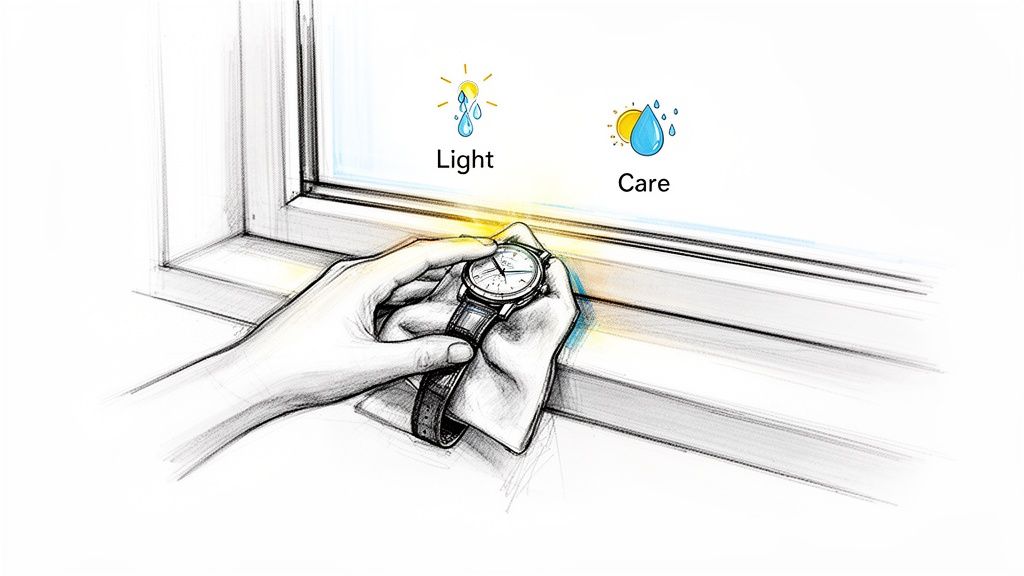
Its main need is light. It’s not something to think about like charging a phone. The watch naturally soaks up ambient light while reading by a window, walking outside, or sitting at a desk. As long as it is not left in a dark drawer for months, it will remain powered.
Life happens. The watch will pick up dust and smudges. A quick wipe with a soft, dry cloth is usually all it takes to bring back its clarity. It’s a small, satisfying ritual. This "buy it for life" mentality is growing. The global solar watch market is projected to reach USD 1,381.3 million by 2030. This isn't just a trend; it's a shift driven by people who appreciate well-made things that last. You can see the full market breakdown on datainsightsmarket.com.
While the movement is self-sufficient, the gaskets that keep water out can wear down over many years. It is good practice to have them checked professionally every so often. Think of it as preventative maintenance, a small tune-up. This is a philosophy we share. Instead of a throwaway culture, we champion preservation. It's why our story includes professional repair services to extend the life of these timepieces. It is about respecting the object and the time it has kept.
Choosing a Watch That Matches a Rhythm
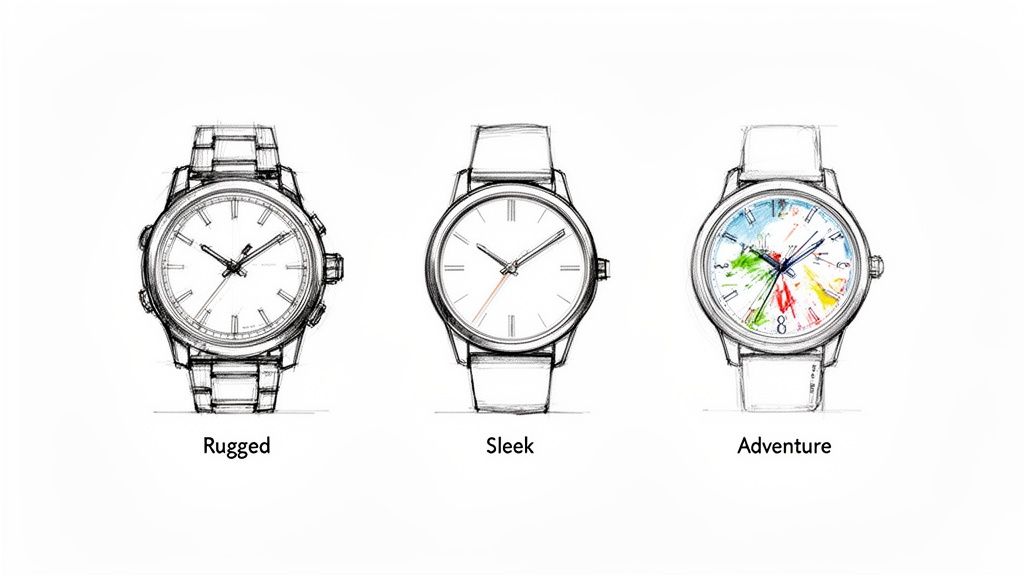
Finding the right watch is about feel. It’s a personal decision that should feel like it was always a part of you. A watch shouldn’t force a persona; it should just fit.
Within the Casio solar watch universe, there are different moods. The rugged feel of the G-SHOCK and Pro Trek lines are companions for days that don’t go as planned. Their designs seem to say, "bring it on." They look right on a wrist that isn’t a stranger to a few scratches.
On the other hand, there is the collected confidence of the EDIFICE collection. These watches move to a different beat, right for navigating a city or a quiet dinner. Their polished steel and clean faces are about precision and structure. It is not about which is better, but which one hums on the same frequency as you.
Think about the simple things. How does it feel on the skin? Does a dial packed with functions feel right, or does a clean, minimalist look bring a sense of calm? There are no wrong answers, only what feels true. In the Middle East, the watch market is growing, and solar models are becoming a choice for both daily wear and collecting. It is part of a larger trend: people want things that merge personal style with technology that works. You can read more about this at Research and Markets.
The best watch is the one you forget you are wearing. It’s the one that complements a favorite jacket and is still on your wrist at the end of a long day. It’s a choice that says less about taste and more about how you move through the world. Our own collection of timepieces is curated with that philosophy in mind—to help you find the watch that feels like it was yours all along.
Our Shared Belief in Things That Last
There is a certain character to the objects that quietly become part of our daily lives. A well-worn chair, a trusted pen. A Casio solar watch fits into that category—a reliable constant in a world of change. This appreciation for things built to endure is something we connect with deeply.
That is the philosophy that drives us at Spectrum. We are not interested in chasing trends. Our focus is to create timeless companions for an everyday journey, crafting watches that feel as right today as they will years from now.
From the beginning, our material has been stainless steel. It is tough, elegant, and has a reassuring presence. We believe a watch should have a familiar weight on the wrist—a silent keeper of memories, from sun-drenched mornings in Jumeirah to long nights in DIFC. It is an object meant to last, not to be replaced.
This commitment to longevity is our quiet way of pushing back against a throwaway culture. By using durable materials and classic designs, we hope to create pieces to be worn and lived with. The idea is not just to make a beautiful object, but one with a future.
We imagine our watches as part of a personal uniform—the final touch on a quiet morning. They are designed to be worn on rotation, not admired in a box. They look just as good with a linen shirt as with a faded denim jacket. This isn’t about comparison, but about acknowledging a shared spirit. A watch that frees you from the cycle of upgrading is a special thing. It is a belief in timeless design and in objects that honor the slow, steady rhythm of a life.
Common Questions About Solar Watches
An object designed to last a lifetime tends to bring a few questions. A watch that runs on light breaks the familiar cycle of winding, charging, and battery swaps, which naturally makes people curious. The questions we hear most are about how such a watch fits into the rhythm of a life.
How Long Does a Casio Solar Watch Battery Last?
The rechargeable cell inside a Casio solar watch is part of its core, not a disposable piece. It is built for the long haul. With regular exposure to light, it is designed to last for the life of the watch, often 10 years or more. On a full charge, it can run for months in complete darkness.
Do Casio Solar Watches Need Direct Sunlight?
No, and this is where the design is clever. Bright sunlight charges it fastest, but it is not necessary. The technology is efficient, sipping power from an office lamp or the grey light of a cloudy day. Just by living your life, you keep it topped up.
Can I Overcharge My Casio Solar Watch?
It is impossible to overcharge it. Every watch has a built-in circuit that stops the power flow once the battery is full. This keeps the internal parts safe and helps the battery remain healthy for years.
What Happens if a Casio Solar Watch Is Left in the Dark?
If left in a drawer, the watch enters a power-saving hibernation mode. The hands may stop and the digital display may go blank, but it keeps perfect time internally. The moment it senses light, it wakes up, and the hands automatically move to the correct time. It remembers, even when sleeping.
If you have more questions about long-lasting timepieces, you can explore our own frequently asked questions section.